skip to main | skip to sidebar

Earthquakes

Monday, November 17, 2008

What are Earthquakes?

Posted by Cameron and Josh at 3:48 PM No comments:
Posted by Cameron and Josh at 3:15 PM 1 comment:

Tuesday, November 4, 2008

Posted by Cameron and Josh at 9:20 AM No comments:
Home
Subscribe to: Posts (Atom)
 

What is an Earthquake?

Earthquakes are natural disasters that happen on our planet. An earthquake happens when the earths plates shift and slide, sometimes resulting with catostrophic results. Scientists say that an earthquake happens almost more then every ten seconds! Earthquakes happen all the time and we usually cannot feel them, there is probably one happening right now. Not all earthquakes are devastating, but as we have seen from the news, they can be life threating. When the Earth's plates shift and move, an earthquake may happen. Earthquakes can cause aftershocks. An aftershock can mean another earthquake. An earthquake can cause a tsunami. This can happen if an earthquake starts under water. Tsunami's are huge waves from the ocean that crashdown onto land. Earthquakes can cause blackouts, fires, and cause buildings to collapse. Earthquakes can happen almost anywhere in the world, but Earthquakes usually happen on faults. A fault is a crack on the earth, where land usually shifts a lot. A fault usually means that that spot of earth is weak. This is where earthquakes come in. If a rock slides on a fault stress is created and if the rock breaks, shaking of the Earth starts. This is generaly how an earthquake happens.

Earthquake destruction pictures

Earthquake destruction pictures
These buildings were struck by earthquakes

People in Earthquakes

Short description of an earthquake

Short description of an earthquake
This is a short paragraph explaining how an earthquake happens

Effects of Earthquakes

The effects of earthquakes are very devastating, and can do millions of dollars in damage. The most obvious effect of an earthquake is "ground shattering". this is the release of energy from two plates that have collided or subducted. Another destructive effect is called "faulting", when faults (large crevices in the earth) start shifting. One particular effect of an earthquake is when waterlogged earth near the surface gives way due to all the vibrations. This is known as liquefication. Another well known effect from an earthquake is an aftershock. Aftershocks are smaller, weaker earthquakes compared to the main quake. The worst effect of an earthquake is a tsunami. When an earthquake occurs, the area forced upward will push the water over the area away. Tsunamis are not to be mistaken for tidal waves, as tidal waves are affected by the gravity of the moon. Tsunamis are usually more destructive than the earthquake that generated them, due to the fact that an earthquake is local to its area, while tsunamis can spread to distant areas.

Earthquake road damage

Earthquake road damage
An earthquke caused this road to split

Building Struck By an Earthquake

Building Struck By an Earthquake
This building was damged by an earthquake.

Technology with Earthquakes

Earthquakes have happened since the begining of time, so it's no wonder that we have made technology to learn more about them. a Seismoscope was invented in the Han Dynasty in China. It was a large statue that had six-eight dragons holding golden balls, if they dropped one into a toad's mouth than an earthquake was coming that way. A seismograph is what we use today. It is a machine that measures the movements of the Earth. A geophysicist or seismologists is a scientist that studies things like earthquakes. Seismologists use seismographs to measure and compare different earthquakes. Earthquakes are sometimes measured through magnitude, to figure out magnitude we use the richter scale. In 1935, an American seismologists named Charles Richter invented the richter scale. The richter scale uses the surface waves and measures the height of them. An earthquake is measured to show a number like 6.3, the higher the richter number the stronger the earthquake is. Today however, seismologists use a different scale. They use a scale called the moment magnitude scale. It is based on the richter scale, but is supposed to be more specific than the richter scale. There are many more scales to measure earthquakes that exist, but there are too many to go into detail.


Earthquake Technology II

Not only are there devices to measure the power of an earthquake, there is also technology to reduce the damage done by earthquakes. One technology is called Base Isolation. A base isolator is put within a base of a building and, in a way, seperates the building from the ground. When an earthquake occurs, the base isolators will keep the building from shaking. Base isolators can also be used for tables as well, as some museums use base isolators to prevent fragile artifacts from falling onto the ground and shattering.

Isolation Table Used to Reduce the Violent Shaking of an Earthquake

Seismic Isolation Table (Animated Version)

Where do Earthquakes Happen?

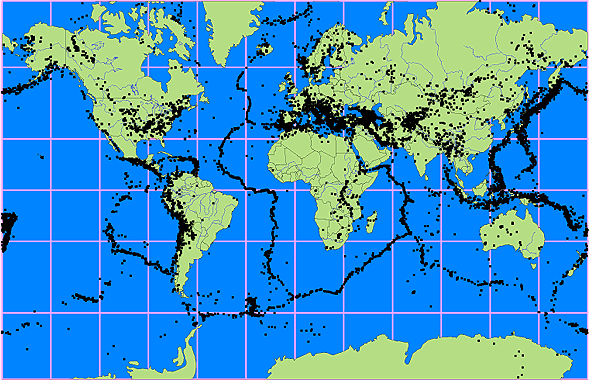
Earthquakes can just about happen anywhere in the world, but they most commonly happen on the edges of the Earth's plates.. First I will explain how earthquakes on plates happen earth The earth has a couple plates, they are separated as continental and oceanic plates. The oceanic plates are obviously in the ocean, and continental plates are everywhere else. A very deep crust of the Earth called the mantle, moves these plates around. The plates are always moving and hitting each other. Earthquakes usually happen when two plates slide against eachother. Earthquakes can also happen on faults. Faults are cracks of the Earth on the edges of the Earth's plates. All the plate's moving and bumping make these faults. Earthquakes happen when these faults slide in opposite directions. There are three different types of faults. They are normal, reverse, and strike-slip. Normal faults are rocks that are moving up or down from each other. Reverse faults are caused by two rocks pushing against each other. Strike-slip faults are two rocks that are moving past eachother, they are not going up or down, they are moving left and right from each other. The San andreas fault in California is a strike-slip fault.

Earthquake faultlines

Earthquake faultlines
Earthquake faultlines all over the world

United States Risk of an Earthquake

United States Risk of an Earthquake
This is a map of our country showing which places have a higher chance of experienceing an earthquake

Earthquakes in Greece

Earthquakes in Greece
This is a map of Greece, it shows which places in Greece has the highest chance of an earthquake happening

San andreas Fault

San andreas Fault
This is a picture of the San andreas fault located in California. It has been known for causing many strong and destructive earthquakes

News Report Showing the recent Quake in China

Tsunami warning after an earthquake in Indonesia

Tsunami warning after an earthquake in Indonesia
This is a picture of a tsunami warning in Indonesia after an earthquake

News Report Showing the Devastating effects of the recent China Earthquake

Earthquake aftermath

Earthquake aftermath
An earthquake destroyed this building

Bloom's Taxonomy

Knowledge: We now know how earthquakes happen, and why they happen.

Comprehension: We learned that earthquakes are a completely natural thing that our planet does, and that earthquakes happen on the Earth's plates and faults.

Application: Earthquakes are from the plate's shifting and sliding against eachother, sometimes resulting in massive destruction.

Analysis: Earthquakes Have been happening since the ancient times and early life of Earth

Synthesis: Technology has shown us that we can now measure the magnitude of an earthquake, and reduce the destruction of the affected area.

Evaluation: Earthquakes will keep happening and we will just have to find out more about them.

Links and sources

  • Building struck by an Earthquake
  • The San andreas fault is a popular strike-slip fault in California, it has caused many strong earthquakes. (commons.bcit.ca)
  • What an earthquake can do(telegraph.co.uk)
  • Road damage caused by an earthquake (elcivics.com)
  • Earthquake risk of happening in United States (endtimesjournal.files.wordpress.com)
  • Indonesian tsunami alert after an earthquake (web.7.bernama.com)
  • Earthquake faultlines (physicalgeography.net)
  • Chances of an earthquake in Greece (sfakia-crere.com)
  • Shortly describing how an earthquake works (howtosurviveit.com)
  • Earthquake destruction pictures (instablogimages.com)
  • Short description of what an earthquake can do (news.bbc.uk)
  • Earthquake video 5 (youtube.com)
  • Earthquake video 4 (youtube.com)
  • Earthquake video 3 (youtube.com)
  • Earthquake video 2 (youtube.com)
  • Earthquake video 1 (youtube.com)
  • Tsunami article (Wikipedia.org)
  • Earthquake article 11 (nisee.berkeley.edu)
  • Earthquake article 10 (geo.mut.edu)
  • Earthquake article 9 (Earthquake.jrank.org)
  • Earthquake article 8 (britannica.com)
  • Earthquake article 7 (encyclopedia.com)
  • Earthquake article 6 (wikipedia.org)
  • Earthquake article 5 (answers.com)
  • Earthquake article 4 (earthquake.gov)
  • Earthquake article 3 (Howstuffworks.com)
  • Earthquake article 2 (Encarta.com)
  • Earthquake article 1 (Nasa.com)